
Policy Points
Candidates were asked these questions for the policy.nz website
The policy.nz website sent emails to candidates and asked for their policies. Wording and word/character counts in the answers below are according to the policy.nz guidelines. Headings and questions are quoted from policy.nz.
Climate change and resilience:
This topic is about preparing for climate change and natural disasters.
Design, build, and maintain robust infrastructure that can handle most extreme weather and survive many natural disasters.
Protect against cyberattacks and solar activity risks by avoiding over-reliance on internet connected or controlled infrastructure.
Use realistic modelling to predict risks. Prevent ‘policy-based evidence-making’ being used to justify schemes such as “managed retreat”.
Environment:
This topic is about protecting the environment.
Ensure ‘prudent stewardship of the City’s common property’ prevails within Council’s culture, including care of the living environment.
Review and reduce Council’s use of hazardous chemicals. Take practical steps to minimise risks to residents, Council staff, and ecosystems.
Rapid removal of rubbish from common property under Council stewardship (streets, parks, etc). Prosecute those dumping in the commons.
Housing and planning:
This topic is about the council's housing and spatial planning activities.
Develop clear and fair rules throughout Council operations. Make people’s interactions with Council systems straightforward and simple.
Transparent planning and contracting processes. This will help provide more predicable costs and timelines for housing developments.
Coordinate with central government, charities, and other organisations to provide social or affordable housing in a responsible way.
Jobs and economy:
This topic is about supporting the local economy.
Invest in building and maintaining core infrastructure. Make economies of scale work. Build surplus capacity to handle growth or crisis.
Attract good people to work and live in the region by creating a well-maintained and functional City, with a Council that respects rights.
Avoid driving people and businesses out of the City. Stop burdening them with excessive rates increases and huge intergenerational debts.
Local democracy:
This topic is about how the council is run and what it does to engage with the local community.
Councillors should have regular drop-in clinics and public meetings in community centres to hear people’s concerns, ideas, and complaints.
Reform Council management to enhance transparency and accountability. Reduce the complexity and the expense of the bureaucracy.
Focus on recruiting, training, and retaining competent staff. Remove public funding from LGNZ and SOLGM; obtain better services elsewhere.
Rates and revenue:
This topic is about how the council will pay for its activities and manage its finances.
Reduce extravagance, wrongdoing, and inefficiency within the bureaucracy. Check if managers & executives have public liability insurance.
Improve contract negotiation practices to reduce costs and ensure that ratepayers benefit from economies of scale or alternative providers.
Reduce Council’s debt and reduce the associated interest costs. Reduce rates when prudent, once core infrastructure is responsibly funded.
Recreation and culture:
This topic is about supporting arts, culture, sports and recreation.
Maintain and provision parks, pools, sports facilities, museums, libraries, and community centres which are used for the common good.
Reduce and remove Council subsidies for commercial venues and other exclusive activities (e.g. Claudelands Events Centre).
Transfer the management and responsibility of most arts and cultural activities to trusts, charities, and other ‘communities of interest’.
Transport:
This topic is about facilitating transport.
Maintain and improve roading and path infrastructure. Make sure designs are functional, adaptable, and reduce conflict between road users.
Reverse the transformational changes designed to punish automobile users. Remove features such as raised crossings and in-lane bus stops.
Stop attempts to use the “Smart City” technologies, and associated ideologies, to monitor and manage the travel behaviour of people.
Utilities and services:
This topic is about services for businesses and residents, such as drinking water, sewerage and wastewater (the three waters), and recycling.
Stop the new water company’s plans to take on huge debts. Stop the projected ~3x increase in household water service costs over 10-years.
Consider disbanding the new water company (CCO) and investigate any deception, faults, fraud, or bad faith dealing used in its creation.
Ring-fence water services revenue and look at forming ‘bulk buying’ consortia to prudently manage water infrastructure costs.
Why are you running for election?
This is a critical time as a range of transformational changes are being imposed on society. Hamilton City Council has been implementing “Smart City” technologies, focusing on managing people’s behaviour, and creating huge amounts of intergenerational debt.
This all needs to be stopped and reversed.
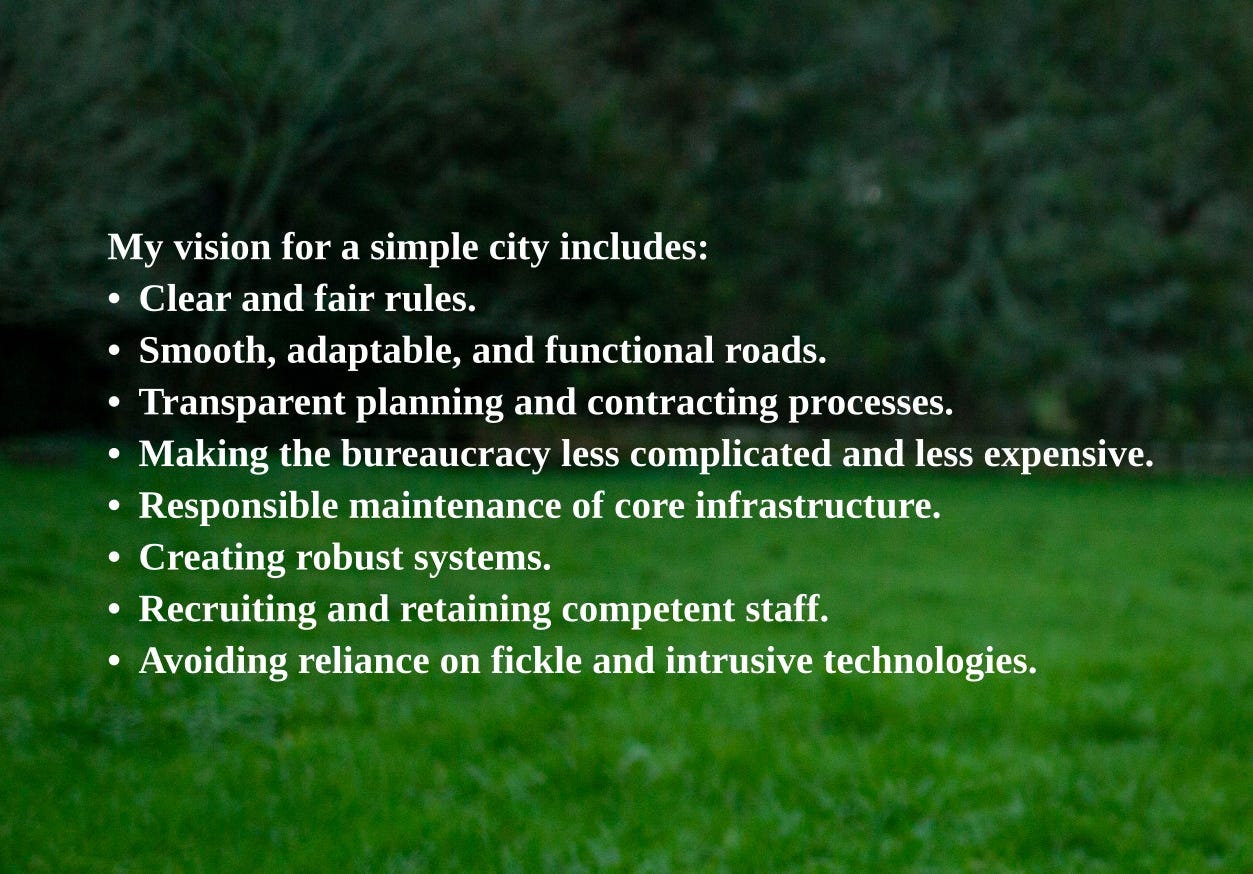
I think the alternative is the ‘simple city’ where we: make the bureaucracy less complicated and less expensive, make infrastructure affordable and robust, respect people’s rights, and practice prudent stewardship.
Why will you make a good elected representative?
I have a more traditional scientific background and strive for objectivity when assessing and analysing situations.
I bring research skills and capabilities for critical thinking. I can handle large quantities of information.
I can be fair, reasonable, practical, and use common sense, while bringing a willingness to strongly challenge government bureaucracy at multiple levels.
I believe in leading by example instead of coercion, with a willingness to let others exercise their rights to self-determination.
What are your top three priorities and why?
Make infrastructure affordable. Stop the City falling into a debt trap. Limit rates increases.
Reverse the “Smart City” agenda. Council should manage infrastructure, not manage people.
Make people’s interactions with Council systems straightforward and simple. Fair and clear rules.
The policy.nz team would like the survey completed by 25 August 2025, though it sounds like they will process some late entries.
I recommend other candidates around New Zealand complete the survey. It looks like a relatively neutral forum without too many leading questions and narrow ‘trap-like’ answer options (in contrast to the Newsroom survey… more on that one later).
I have posted my answers early so that other candidates have an example to look through. If you are another candidate here to ‘borrow’ some policy ideas and key phrases from this page, that is alright. However, carefully check what you are using and be prepared to stand behind it during the election and after the election. Note that some points are Hamilton City specific and some will be regarded as edgy and controversial. Re-use with caution.
[Note some minor edits were done to this page at 5:50pm on 23/08/2025 to fix a few typos and improve readability]